Tuesday, February 28, 2012

Aero rake in F1, RB8

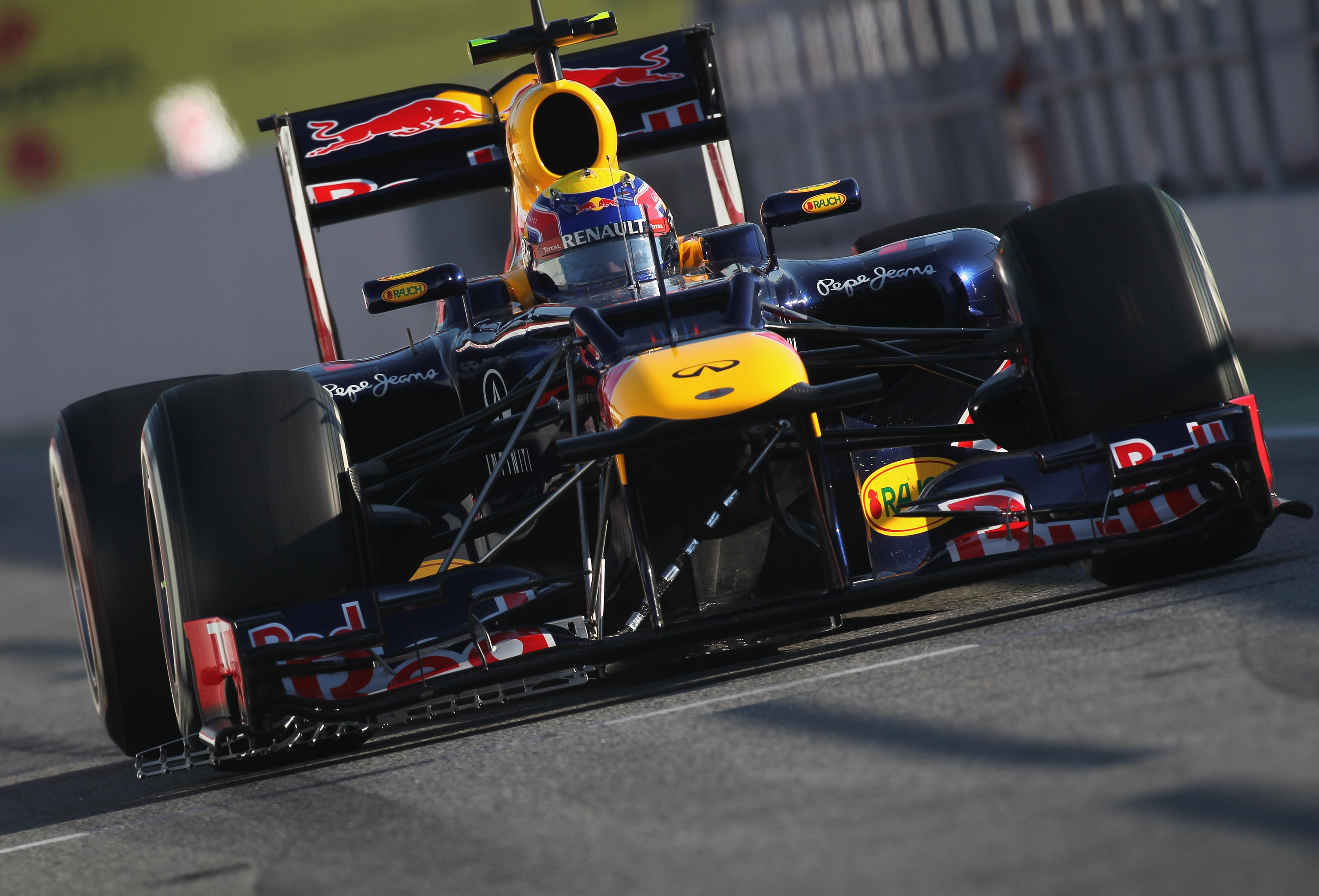
A short article on what is aero rake (as usual, an attempt with simple words) and how it's being used in F1, for example Red Bull Racing and their front wing. The following picture is from Barcelona testing 2012, day 2, and is originally located here, at http://f1.f-e-n.net

Red Bull Racing (RB8, Barcelona 2012, day 2).
Photo credit: f1.f-e-n.net
Shown picture scaled down, larger image available (click)

Above you can see the setup of RB8 done at the front wing.
The idea is simple: through controlled setup to find out and understand wing's behavior in different airflows.
This is a useful data when you plan to use different wing ride height parameters, and in general to measure how the flow works out around the wing.

First, there are cables holding the wing and preventing the usual plunge. This is done in order to achieve constant results, usually used in conjunction with straight line permanent speed run.

Then, we have laser ride height sensors, which I can't spot on that picture, should be on endplates (if any at all) which are used to measure the ride height at the end of the wing. Usually, there's a third sensor in the middle, under the nose, who's a benchmark and the deviation would be your amount of flexibility.
I.E. the tips of the wing are measured to maintain max clearance of 10mm, whereas the center sensor shows
15mm, so the wing flexes at the tips up to 5mm compared to the center line. This way you can monitor and adjust your wing parameters.

The aero rake itself could be used for measuring air speed, angle flow, pressure (Pitot-Static probe) and even temperature. Since the cables are holding the wing and the lasers are measuring just how much exactly does it flex, the sensors on this two-row aero rake are collecting data on wing's wake and thus creating effective and data-rich info sheet.

What is really a Pitot tube?
It's a thin tube that has two holes - the front hole is located to face the airstream for measuring the stagnation pressure. For incompressible flow (where the material density is constant) it is a sum of the dynamic pressure and static pressureThe side hole measures the static pressure and the difference between these two is dynamic pressure, which can be used to calculate fluid flow and speed, in our case that's the air.

Another point of installment of aero rake could often be seen in front of the tires, or right behind the sidepods, for example, just like Red Bull did in Canada FP. That's a custom shaped 34 sensors grid mounted on a bulge, above the sidepod.
Image credit: formula1.com


Friday, January 20, 2012

Lotus and the anti-dive system


Much has been recently written about the alleged system Lotus-Renault will use in its 2012 competitor.

The system is aimed to be of anti-dive type, thus help maintaining standard ride height during braking, while the usual movement would be to plunge onward and down.

Here's a technical diagram: 

Image courtesy of Omnicorse, original here.

At the same time Ferrari have reported that they are working on the same type of system, but they are 
awaiting final approval from the FIA over its legality.

Reportedly, FIA said OK to such system, as it has been found legal according to the rules, so lots of noise has been created about how the rest of the grid will have to copy that setup.

Red Bull, in the mean time, say that "there's no reason to rush and copy", as 
"Things have to work as a package rather than as individual components."
It has been reported that in the past Red Bull have tried similar approach, but it has been abandoned, perhaps in favor of working more deeply and actually developing the winning EBD concept, as I've described (translated) here.

On the other hand, the news on the Red Bull front have been virtually equal to zero, so I would assume they are quite busy at this time, which might explain why the unveiling of the car will be done online.

Let's rewind on the anti-dive systems, that's hardly the first time we hear about it. 
  • Back in the 70's we had Lotus 72, which had very advanced suspension geometry, including such anti-dive system. 
  • Then we have Honda's TRAC system, seen in the CB900F model, which was again back in the time, namely the 80's. 
So, those examples are here just to illustrate that such system isn't new to the world. Now, back in F1 and if you prefer the visual style, here's a video explanation.
Note: Personally I see a bit of contradiction with : 

10.2.3 No adjustment may be made to the suspension system while the car is in motion. 
But honestly, I don't know what's really going to happen.

Some speculate that such setup could be a real gainer, with selective quotes up to 0.5 seconds per lap, but personally I would disagree. Such ride height control systems are present in the cars to some extent, depending on the car setup and overall philosophy, and I don't find it such a great gizmo that can greatly boost the performance of any team.

I'd rather call it an "aid" to a properly thought of and crafted car, as the suspension travel is very small, thus the gain would be max if one can utilize the effect of the travel along with the rest of the setup of the car.
This means that such system will have effect if the front end of the car is designed carefully around it, as well as the rest of the package.


There's a pretty good advantage, however, on the fuel load side, as the cars start with about 150 kg of fuel, and lighten up throughout the race. The inference is up to you.

Certainly, what's really going to happen, we're about to see.


UPDATE: 28.09.2012 - James Allison told PMWM about the system: "It was complicated. “Done wrong, you could get quite a nasty brake judder with this bouncing caliper. Engineering it so the car moves up exactly the amount that it would otherwise have dipped down by – that’s all quite beautiful when you get it right. We were rather proud of having done it and were looking forward to using it.”


Wednesday, January 4, 2012

RB7 - The Red Bull F1 Racing Car and its core success values

The following text is a best effort translation - the original source is located here- the article is in Bulgarian, its author is Ivan Tenchev - Editor in Chief at ClubS1 Magazine. I have his explicit written permission to link it here, which I'm thankful for.

The aim of that translated article is simple - to get this excellent content reaching more people, interested just as me in the huge success of RB7 - The Red Bull F1 Racing Car and overall in technical stuff related to F1.


Going back into 2011, it's quite obvious that the advantage RB7 had was more than phenomenal. We witnessed light-speed-like qualification laps and race pace which was often unreachable even for the top teams like Ferrari and Mclaren.
So, what really lies underneath that rocket ship? Let's go down into the details.

BASE CONSTRUCTION
Even from a basic view it's very evident that the car has its roots related to the predecessors - RB5 from 2009 and RB6 from 2010 - they are all from the same breed.
When FIA ratified the most radical rule change since the beginning of 80's Adrian Newey saw an excellent opportunity to create brand new concept of a car, and including many forgotten elements.

  • Rear suspension of pull-rod type was introduced - the main driver for that choice was, as the constructor himself explained, that many elements are getting more and more closer to the floor, thus overall lowering the center of gravity, and as a subsequent benefit making the rear more tightly packaged. This allows the bottom element of the rear wing to be lower, thus improving downforce without loosing the straight line speed. 
  • At the same time a high-profile nose was selected along with a front wing situated as close as possible to the ground, whose sides were rather high, aiming to direct the air outside, around the front wheels, and not to do complex modeling towards the floor of the car.
    The reason for that change was allowed by the rules and discovered by Newey - the width of the front wing became 1800mm from 1400 providing that the overall car width was 2000mm.
  • The next choice was the selection of Renault engines - not as powerful as the others, however requiring less cooling and being very flexible at the same time. 
Newey was already working on old-known concept - the infamous diffuser blowing with gases passing through the motor and creating constant downforce stream on the rear end.

It's also curious to mention that all of Newey's ideas are first drafted on the old-fashion drawing board, and then the schema goes through the CAD -> CFD - Aero-tunnel cycle.
Author's note: I mean this:


THE KEY ROLE OF THE DIFFUSERS
The 2009 project was really strong and it's worth mentioning that the key role was played by the single diffuser. Recently Newey revealed that he wouldn't have gone into pull-rod suspension, if he knew that FIA would allow the double diffusers of Brawn, Williams and Toyota:
Newey: For a single diffuser the pull-rod is very elegant solution, but the height of the double diffuser per se will create many problems.
However, given that fact that the Double Diffuser turned out to be a key element in 2009, Newey had to open the rear part of the floor and, surprisingly, in Monaco 2009 the car was with double diffuser and later was able to surpass his opponent, Brawn - a car made specifically with double diffusers in mind.

Then, in 2010 RB6 was already built around the double diffusers, the car was very fast, but there were problems, too. Most of the ideas from 2009 had to be combined with the new changes, amongst which was the bigger fuel tank - a consequence of the refueling ban. That led to a compromise with radiators' size, which were to bound with the overall idea of the construction.
The aerodynamic was still very good, the additionally lifted rear part was much more flexible to play with when blowing the double diffusers with exhaust gases.

Having the front wing very close to the ground, along with the overall rake of the car onward, was assuring very clear stream underneath the car. There was playing and fine tuning with the balance and the weight of the details, in order to optimize the work of the tires and the brakes.

For 2011 the double diffusers were banned, and a mandatory weight distribution was introduced, namely: 291 kg on the front and 342 kg on the rear axis. Hence, having in mind the minimum weight of 640 kg, Newey had only 7 kg to play with, but he made that move brilliantly, by putting them in the front part.
That way the car was able to heat the front Pirelli tires up to optimal temperature faster than anyone else.
Basically the front tires are more problematic in getting up to temperature, and even that could explain the excellent performance of Red Bull in the qualification sessions.

It was also evident, however, that RB7 was beginning to wear out the tires in the high-speed turns faster than the rivals like Mclaren and especially Ferrari. But on the other hand, such corners are not present on most of the F1 tracks. The bottom line was that Red Bull was having issues on classic tracks like Silverstone and Germany, so they decided to sacrifice them in favor of the newly introduced tracks.

On the rear of the car a single, optimized diffuser was used, which was very close to the whole concept of RB5, which was actually an advantage from a structural and aerodynamic point of view.

THE MAIN PROBLEM
RB5 was created to work with KERS, too, but in Red Bull quickly dismissed the system after the first tests in 2009. For 2011, however, the use of the system became mandatory and that turned out to be the biggest problem of the team, because unlike the others, they had no prior racing experience with it. At the same time they were trying to further improve the system, separately from Renault, whose development they were using as a base package.

Having aerodynamics as a main priority, Newey selected some unorthodox solutions for the system. First he put the batteries and the electronic control block on both sides of the car under the radiators. All other competitors, considering the experience from 2009, put all those units in the middle, under the fuel tank.
At the same time, concerned about the large size of the fuel tank, and in order not to break the overall balance, Newey decided to use smaller lithium ion batteries, which would require less energy for cooling purposes. This way he avoided the need of larger radiators for KERS cooling.
The smaller batteries, however, produced smaller power output, equal to about 60 HP, as opposed to the 80 HP for the rest of the grid.
It's also worth considering the fact that the system itself was fragile in terms of reliability, thus rendering it unusable, which might explain the smaller time differences in the races, compared to the rivals.

THE SOLUTIONS
Having extra bag of useful knowledge, Newey and his team had a solution for those issues. The setup of the car was modified to be very fast in one lap and thus getting P1. Then, with a good pace for a couple of laps (while others were still heating up the tires) they had more than 1 second advantage, hence being invulnerable to the rival's DRS system and then keeping up to speed.

In order to achieve that behavior, the setup of the aerodynamics itself was very important. The car was primarily setup to be fast in the bends, with a trade-off for lower speed on the straights.
In Germany, for instance, Mark Webber still managed to snatch the pole position, regardless of the fact that RBR were 5 km/h slower than Renault on the straights.

In the race, however, the leadership was inevitably lost. The telemetry data analyzed by the other teams showed the great advantage that Red Bull had in the bends - they were able to use second and third gear!
There was a new transmission available from the Milton Keynes team - although in general it was the same as in 2009 and 2010, it had a new housing and different gear ratios, in accordance with the current setup and KERS and everything else meaningful.
That particular choice of gear ratios can talk a lot about the team and its dedicated work in regards to mechanics and dynamics as a factors, forming the overall package.


SAFETY AND RELIABILITY
Undoubtedly, Newey is genuinely talented in aerodynamics - but as he mentions himself, he has graduated in aeronautics, too.
It's also true that since the late 70's the aerodynamics is a leading part of Formula 1, but at the same time his team put a lot of attention to the mechanics (transmission as an evidence), as well as the safety.

In the recent seasons a laser system by Leica was introduced in Milton Keynes. It checks each one of the details produced and RB7 became the most safe and reliable car in 2011, which managed to complete all of the 1362 laps possible in the first 11 races. Besides, both drivers have scored points in every race.

So, yes, Williams FW14B and Mclaren MP4-4 were truly amazing capable pieces of machinery, but RB7 is also very special, even though not having all of their huge superiority.


Thanks for reading all the way down - I'll be glad to share more and more insights from Ivan Tenchev and ClubS1 Magazine.
You can follow their account at Twitter - @ClubS1Magazine


Thursday, December 15, 2011

F1 2012 rules, early tests

The goal of this article is to inform the interested reader about the changes we're going to witness in Formula 1 during 2012 season.

SUMMARY
  • Off-trottle diffusers and "exotic" engine mappings will be gone. The original incremental ban of that technology was supposed to be finalized at UK, Silverstone, however, the teams, mostly Mercedes and Renault powered engines protested, and FIA decided to postpone the full ban until 2012.

    Excellent article on further solutions, dimensions and explanations could be found at Craig Scarborough's site, mostly known as @ScarbsF1.
  • Most of the teams have complained about the lack of in-season testing, so it will return in 2012 - the plans are for May 1, at Mugello. 
  • The nose of the cars is going to be changed, namely, its height.
    Besides that it will affect the aerodynamics part, the main aim is actually safety. Another, subsequent benefit is improved visibility for the driver. 
  • Car floors - the technical regulations dictate that the floor must be flat, but since it's kind of hard to produce absolutely flat structure, a manufacturing tolerance of +/-5mm was permitted.
    Later is has been perceived that some teams may use that tolerance to design allegedly an illegal solution, so that metric has been lowered to +/- 3mm.

The rest of the changes aren't that technical, nor they seem too significant to me.

The above stated, however, are likely to drive a change in current positions, since the diffuser will no longer be blown in the same way as it is now. The team that it's believed to suffer the most is Red Bull, although these are rather a speculations at that point.
The rationale is that Adrian Newey has spent more than two years developing and improving that concept, which obviously resulted in a dominant car, but now he has to start from scratch.

Note: the above rules are still not published officially, but today, 15.Dec.2011 AUTOSPORT reports that
Ferrari says its new F1 car will be ready for first test in February, which should mean that the team has a green light to work on core components like chassis, monocoque, exhaust layout, etc, because anyone who has been involved in engineering knows that it takes more than just producing parts in pure manufacturing terms and then bonding them together - you need to have solid grounds in terms of concepts and design.

This is why I think that the rules aren't going to be changed dramatically at that point - it may be too late and the teams are likely to complain about it, if it happens.

THE EARLY TESTS

The Young Driver Test program was the very first chance for the teams to try live the revised exhausts.
Three teams came prepared - Mercedes, Williams and Ferrari.

While both Mercedes and Ferrari ran an exhaust position that won't be legal in 2012, they just wanted to remove the blowing effect of the diffuser, this is how the Williams setup looked like:

Image courtesy of ScarbsF1 - http://scarbsf1.wordpress.com

Although it's believed that similar solutions will be adopted, there's always room for more interpretation.
Even more insight could be found again on ScarbsF1 blog, as I simply don't want to reiterate what has been written.

This is how the things look so far - the rest of the teams - Red Bull and Mclaren, haven't made particularly bold statements, except for the admission of Adrian Newey that it will be hard to stay on top in 2012.

To me, that doesn't tell much, just as well as the lack of talk from Mclaren, so no rough estimations as of yet.
Most of all, I just hope for a competitive racing 2012 season, given the return of the world champion Kimi R. with Renault, henceforth knows as Lotus Team.


Wednesday, October 19, 2011

Why the 2012 development began in mid September 2011

We're in the middle of October, however, three races prior to the end of 2011 season.
This is the time of the year when we are already seeing some interesting F1 development stuff.

First I'll stop at Maranello, the home of Ferrari.

  • At Korea the Italian team has been spotted to test a new front wing, link here
  • It's visible that the wing per se resembles an RBR style, and it was tested only on Alonso's car. While it hasn't been a large performance boost, it was actually expected to be a driver for data gathering.
  • Stefano Domenicali himself said that the information collected from the actual race correlates with the preliminary wind tunnel data, so he's quite happy with that.

  • In the race it was visible that Ferrari had much better pace with the Soft tires provided by Pirelli, something that wasn't expected, or at least not to this extent. 
Things are looking pretty aggressive for the Scuderia, in their approach for championship-winning car for 2011.

My next stop is the Mercedes team.
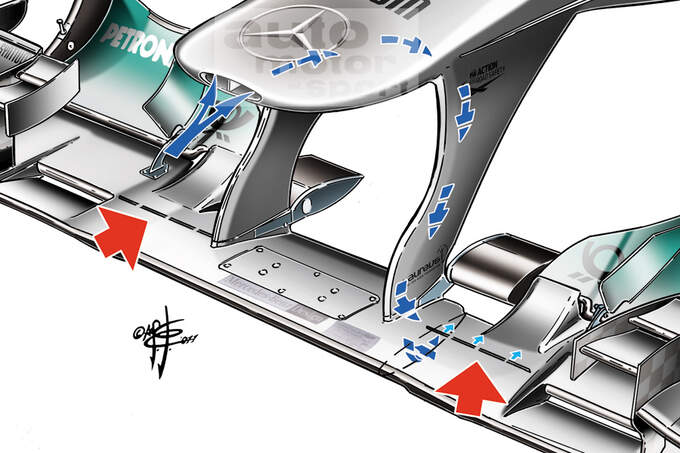
In the last races an interesting solution seems to be developed by them, namely, a passive "F-Duct" like system, located at the nose of the car. In details:


This front hole in the nose is believed to be used for cooling purposes, like electronics and the cockpit itself, but it appears that Mercedes GP team is experimenting with actually flowing air through this holes.
There's a splitter inside that hole, which is supposed to effectively flow air down the front wing.
It has been also revealed that this hole has been spotted both opened and closed, so clearly there's development going on.

It remains to be seen whether actually some of these will be deployed, and whether such solution will be considered legal. On the other hand, it's also believed that some teams are already exploiting that area.

Update: after looking a bit more into the whole concept, I'm rather skeptical that a meaningful amount of air could be channeled through those small inlets, in terms of enough air to divert to the back (or the floor) of the car.
Also, the air that has to travel through those curved / shaped object will have to face a lot of pressure, and thus will lose its initial energy and there will be a substantial loss. The air should rather be travelling from the reverse direction and possibly destroy a flow, thus stall a part of the wing?

Further reports are appearing, again at MGP side, that some interconnection between the front and the rear suspension is possible through a clever system, but for that material I will have to contact the respective owner and get a permission to link it over here.

No big news so far from Mclaren team, it's probably worth saying, however, that the chief architect of RB7, Adrian Newey, has been away from Korea GP, and it was reported by team principle Horner that he's back at the factory at Milton Keynes to work on RB8 car.

More blog posts to follow about 2012 rules itself.